Single-Molecule Electret (SME)
Single-Molecule Electrets (SME) are a breakthrough materials technology in which a single molecule exhibits spontaneous polarization, enabling intrinsic memory functionality.
Designed to meet the core demands of next-generation electronics — smaller size, lower environmental impact, and higher performance — SME opens new possibilities at the molecular scale.
Smaller
Ferroelectric materials exhibit spontaneous electric polarization that can be switched by an external electric field, enabling memory functionality.
They are widely used in devices such as memory, sensors, actuators, and capacitors.
In conventional ferroelectrics, spontaneous polarization arises from asymmetric crystal structures and requires the alignment of many molecules or atoms.
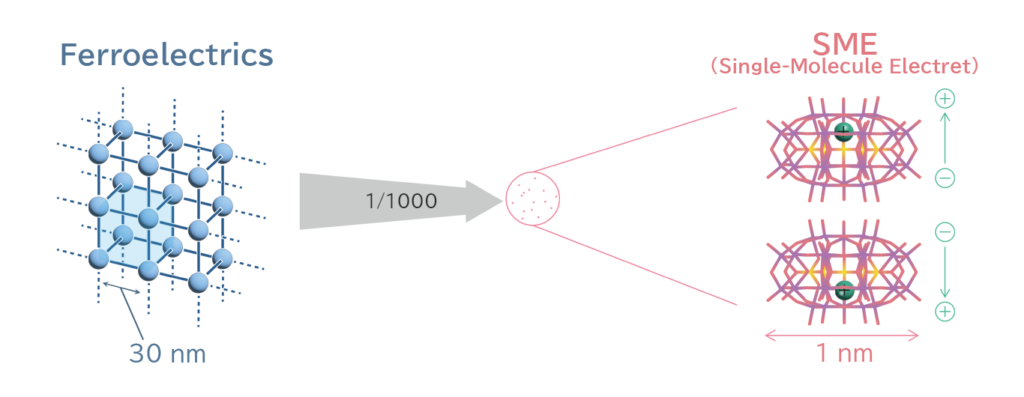
This means that tens to hundreds of unit cells (typically >30 nm) are needed, making further miniaturization difficult.
In 2018, a research group led by Professor Nishihara at Hiroshima University reported a new class of materials — Single-Molecule Electrets — that exhibit spontaneous polarization within a single molecule, beyond the scope of conventional ferroelectric theory.
Single-Molecule Electrets consist of a ~1 nm Preyssler-type polyoxometalate cage encapsulating a single terbium ion.
The position of the ion generates spontaneous polarization, and this position can be switched by an external electric field.
Despite providing ferroelectric-like functionality, Single-Molecule Electrets are nearly 1/1000 the size of conventional ferroelectrics, enabling ultra-miniaturization previously considered impossible.
Material Gate is developing devices based on Single-Molecule Electrets to realize smaller and thinner ferroelectric devices.
Lower Environmental Impact
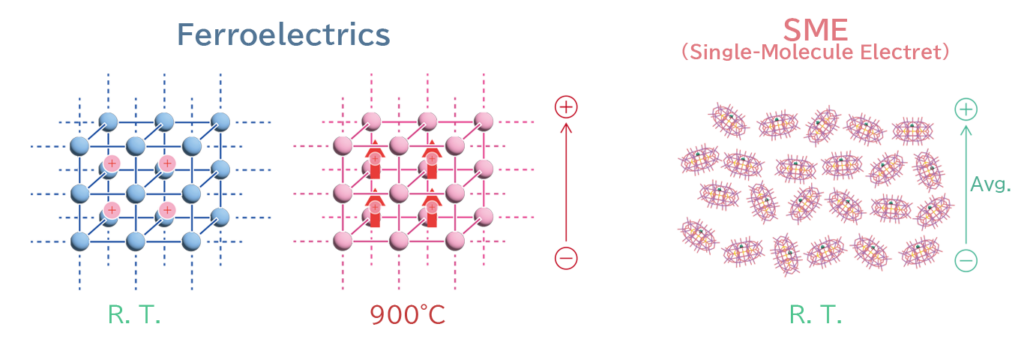
Conventional ferroelectric materials typically require high-temperature annealing above 900°C to exhibit spontaneous polarization, increasing energy consumption and thermal stress during device fabrication.
Single-Molecule Electrets eliminate this requirement.
They exhibit spontaneous polarization at room temperature and under normal conditions, without any high-temperature processing.
Removing thermal annealing simplifies manufacturing, reduces heat damage to devices, and significantly lowers energy use.
As a result, Single-Molecule Electrets enable a more sustainable device process, reducing both power consumption and associated CO₂ emissions — an outcome difficult to achieve with conventional materials.
Higher Performance
Single-Molecule Electrets deliver ferroelectric functionality at the scale of a single molecule, unlocking performance beyond conventional ferroelectrics.
Their properties can be precisely tuned through molecular design.
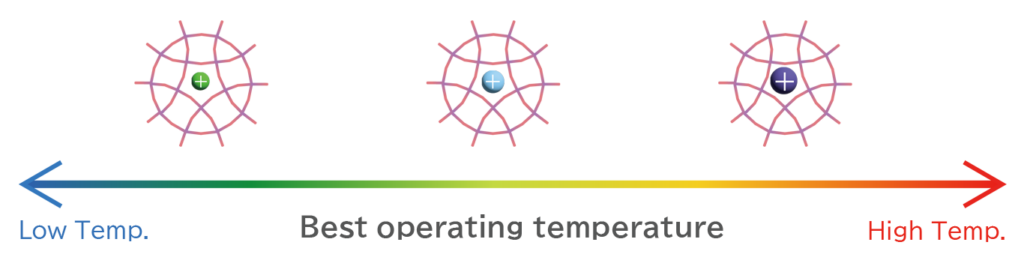
By modifying molecular structures or encapsulated ions, key characteristics — such as polarization behavior and operating temperature — can be systematically controlled.
In addition, changing counter ions enables compatibility with both aqueous and organic environments, offering processing flexibility unavailable in conventional ferroelectrics.
Single-Molecule Electrets also retain their functionality when mixed with other materials.
Because their polarization does not depend on crystal structure, they remain active in non-crystalline systems, such as polymers or resins.
With added benefits such as transparency and flexibility, Single-Molecule Electrets represent a fundamentally new materials platform — built for next-generation devices.